
TPO Roofing
TPO Roofing in Austin: Commercial Installation & Repair
TPO roofing in Austin costs approximately $8 to $14 per square foot installed on typical commercial low-slope buildings, with 20- to 30-year expected service life depending on membrane grade and detailing. Tarrytown Roofing installs 45-mil, 60-mil, and 80-mil TPO on new construction and reroofs, backed by a Malarkey Certified Pro Contractor certification and the Directorii $250,000 project guarantee.
Overview
What to know before you decide.
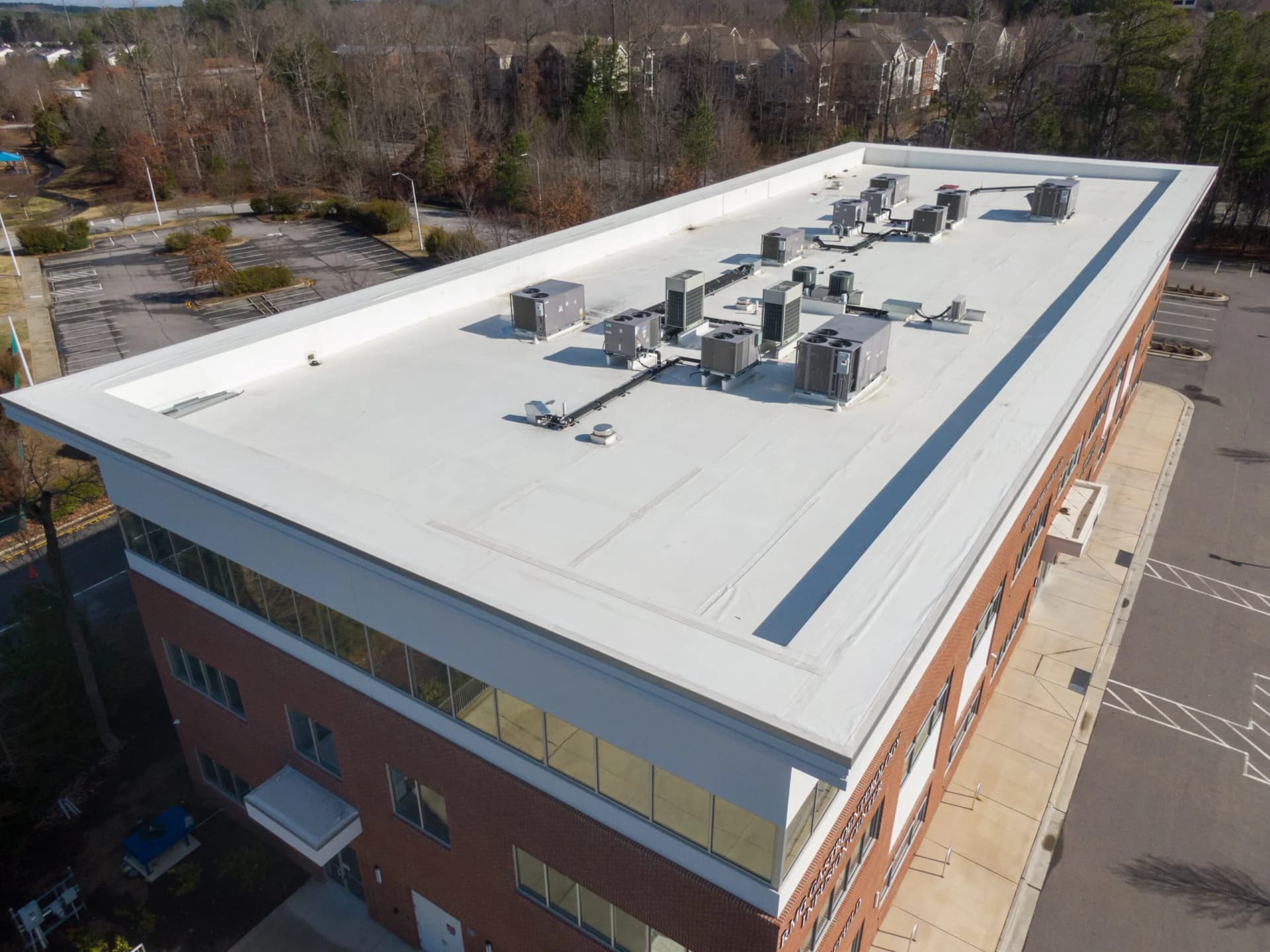
TPO earned its Central Texas market share on cost and cool-roof performance. It costs roughly $8 to $14 per square foot installed depending on membrane grade, insulation package, and site access. On peak Austin summer days, a white TPO roof can reflect 70 to 85% of solar radiation, cutting cooling load 10 to 25% on typical commercial buildings.
The system lasts 20 to 30 years in Central Texas depending on membrane thickness, insulation R-value, and detailing quality. Where TPO fails, it fails at the seams, which is why heat-welded seams and skilled installation matter more than membrane thickness alone.
Options
TPO membrane thicknesses we install
01
45-mil TPO
02
60-mil TPO
03
80-mil TPO
04
TPO reroofs (recover systems)
05
TPO retrofits with tapered insulation
Is it right for your building
How to know if TPO is right for your commercial building
01
Budget
TPO is the value-tier single-ply commercial system at $8 to $14 per sq ft installed. Competitors: EPDM (rubber, $6 to $11), PVC (premium, $12 to $18), modified bitumen ($5 to $9).
02
Climate & energy
White TPO's high solar reflectance (0.70+) makes it the strongest cool-roof choice for Central Texas heat. Look for ENERGY STAR ratings on the specific membrane grade.
03
Building type
Best for offices, retail, hospitality, warehouses, and low-slope multi-family. Marginal on buildings with heavy chemical exposure: PVC handles chemicals better.
04
Roof access & traffic
60-mil is the default; 80-mil for buildings with frequent HVAC access or heavy foot traffic. 45-mil only where budget is tight and access is minimal.
05
Lifecycle cost
Amortized over 20-25 years, 60-mil TPO usually delivers the lowest total-cost-of-ownership among commercial single-ply options in Central Texas.
Trade-offs
TPO roofing: pros and cons
Advantages
Cool-roof energy performance
White TPO reflects 70 to 85% of solar radiation, cutting summer cooling load 10 to 25% on typical Austin commercial buildings.
Chemical & ozone resistance
TPO's polymer chemistry resists most common industrial exposures without degrading. Better than EPDM for many applications.
Heat-welded seams
TPO seams are heat-welded to fuse into a monolithic membrane: no adhesives to degrade, no fasteners to corrode.
Fast installation
Mechanically-attached TPO installs quickly with minimal disruption to building operations. Most 10,000 sq ft roofs finish in 5 to 7 working days.
Reroof-compatible
Can install directly over existing sound membrane, saving 30 to 40% versus full tear-off.
Lower carbon footprint
TPO is fully recyclable and its cool-roof properties reduce urban heat-island contribution.
Disadvantages
Seam failure risk
Where TPO fails, it fails at seams. Skilled heat-welding is non-negotiable: cut corners here and the roof leaks in 5 years.
Puncture susceptibility
45-mil membranes puncture easier than PVC or thicker TPO. Rooftop equipment installers walking with tools can damage the surface.
Shorter proven lifespan than PVC
TPO has 20+ years of Central Texas field data; PVC has 40+ years. On buildings owned for 30+ years, PVC's longer track record may justify the premium.
Manufacturer variability
Not all TPO membranes are equal. Membrane chemistry varies between manufacturers: some early-2010s TPO installations failed prematurely from poor formulations. Stay with proven manufacturers (GAF EverGuard, Carlisle Sure-Weld, Versico Versicoflex).
Commercial roof consultation
TPO Roofing? Let's book a walk-through.
A senior estimator + commercial PM walks the roof, evaluates the system, and delivers a written scope within 24 hours.