
Blog
Underlayment Systems for New Roof Installations
Published 2026-07-07T00:00:00+00:00
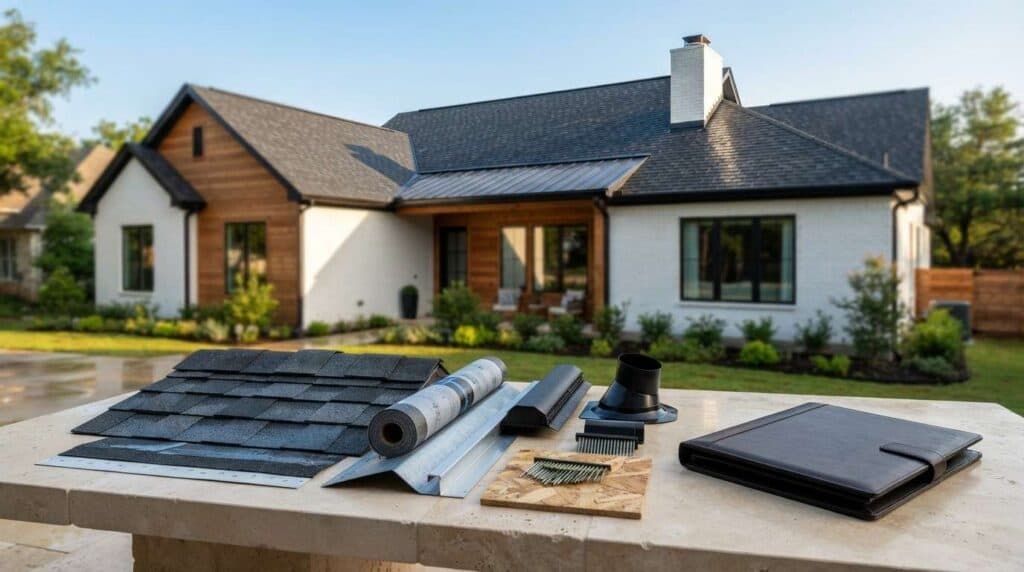
Underlayment Systems for New Roof Installations Roofing underlayment is the protective layer installed directly on your roof deck beneath the shingles and choosing the right system is one of the most important decisions in any new roof installation. Most homeowners focus on shingle color or material, but underlayment is what stands between your home and…
Roofing underlayment is the protective layer installed directly on your roof deck beneath the shingles and choosing the right system is one of the most important decisions in any new roof installation. Most homeowners focus on shingle color or material, but underlayment is what stands between your home and water damage when shingles are damaged, lifted, or missing. In Austin's climate, where summer heat, high humidity, and hail season all stress roofing systems, the underlayment you choose matters more than many homeowners realize. This guide covers the three main types of roofing underlayment, how to choose the right one for your roof, what the installation process looks like, and what it typically costs for a new roof in Austin, TX.
Roofing underlayment is a water-resistant or waterproof layer installed directly on the roof deck, beneath the primary roofing material. It acts as a secondary moisture barrier, protecting the structural decking from water infiltration if shingles are damaged, displaced by wind, or allow wind-driven rain to pass through. Without underlayment, a single compromised shingle can allow water to reach the decking, leading to rot, mold, and structural damage that costs far more to repair than the underlayment itself. It also helps manage condensation and provides a degree of thermal protection between the exterior roofing material and the interior of your home. Roofing underlayment is one of several critical components that work together during a new roof installation our guide covers every layer of the process, from decking preparation through final shingle placement, so you understand exactly what goes into protecting your home.
Underlayment serves three primary functions beneath your shingles. First, it provides a secondary water barrier if shingles crack, lift, or blow off in a storm, the underlayment prevents water from reaching the decking immediately. Second, it protects against wind-driven rain, which can force water horizontally under shingles even when they are intact. Third, it guards against ice dams and condensation in climates where temperature swings cause moisture to accumulate at the roofline. In practical terms, underlayment is your roof's last line of defense before water reaches the structure of your home. Proper selection and installation directly affect how long your roof performs and whether your manufacturer warranty remains valid.
Three main types of roofing underlayment are used in residential new installations: felt underlayment, synthetic underlayment, and self-adhering (peel-and-stick) underlayment. Each differs in composition, moisture resistance, durability, and cost. Understanding the differences helps you have an informed conversation with your contractor about what is right for your specific roof.
Felt underlayment is the traditional standard an asphalt-saturated paper or fiberglass mat that has been used in residential roofing for decades. It comes in two weight grades: #15 felt, which is lighter and used on standard residential applications, and #30 felt, which is heavier and more durable for steeper pitches or more exposed roof areas. Felt is the most cost-effective option and meets code requirements for most standard asphalt shingle installations. Its primary limitation is moisture absorption felt can absorb water if left exposed during installation delays, which can cause it to wrinkle and create an uneven surface beneath shingles. It has largely been replaced by synthetic underlayment on new installations, though it remains a viable and code-compliant choice for many projects.
Synthetic underlayment is a polymer-based sheet, typically woven or non-woven polypropylene or polyethylene, that offers significant performance advantages over traditional felt. It is lighter, more tear-resistant, and far more moisture-resistant than felt, making it the preferred choice for most new roof installations today. One practical advantage for Austin homeowners is the UV exposure window synthetic underlayment can be left exposed to sunlight for weeks or months during installation delays without degrading, whereas felt must be covered quickly. Synthetic also provides a slip-resistant surface for installers, improving safety on steep-pitch roofs. Synthetic underlayment is part of a broader shift toward synthetic roofing materials that offer longer service life and better moisture resistance than traditional options, making them increasingly common on new residential roofs in Austin.
Self-adhering underlayment, commonly called peel-and-stick or ice and water shield, is a rubberized asphalt membrane with an adhesive backing that bonds directly to the roof deck. Unlike felt or synthetic, it creates a fully waterproof seal rather than just a water-resistant barrier. Peel-and-stick is most commonly used in high-risk zones valleys, eaves, around chimneys, skylights, and other roof penetrations where water is most likely to concentrate. It can also be applied as a full-roof system on low-slope roofs where standard underlayment does not provide adequate protection. It is the most expensive of the three types, but in the areas where it is required, there is no effective substitute. Some manufacturer warranties and local building codes require peel-and-stick coverage in specific zones regardless of which underlayment covers the rest of the roof.
Choosing the right underlayment depends on five factors: your roof pitch, your local climate, your primary roofing material, manufacturer warranty requirements, and your budget. No single type is universally best the right choice depends on how these factors interact for your specific home. Selecting the correct underlayment starts with understanding your roof pitch and slope , since low-slope roofs require higher-grade moisture barriers than steep-pitch designs that shed water more quickly.
In Austin specifically, the combination of summer heat, high humidity, and hail season makes synthetic underlayment the practical choice for most new installations. The UV exposure window is a real advantage during Austin's longer construction seasons, and synthetic's tear resistance holds up better under hail impact stress than felt.
Proper underlayment installation is as important as product selection. Even the highest-grade underlayment will underperform if it is installed with insufficient overlap, inadequate fastening, or gaps at critical zones. Understanding the installation process helps you ask the right questions when reviewing a contractor's scope of work. Installation begins at the eaves the lowest edge of the roof and works upward in horizontal courses toward the ridge. Each course overlaps the one below by a minimum of 2 to 4 inches for standard underlayment, with greater overlap required at valleys and other high-risk areas. Fastening is done with cap nails or staples at intervals specified by the manufacturer, and all edges, penetrations, and transitions receive additional coverage before shingles are applied.
Asking your contractor to walk you through these steps before work begins is a reasonable and informed request. How a crew handles underlayment installation is a reliable indicator of overall workmanship quality.
Underlayment material costs in Austin typically range from $0.10 to $0.20 per square foot for standard felt, $0.25 to $0.50 per square foot for synthetic, and $0.50 to $1.00 or more per square foot for self-adhering membranes. On a 2,000-square-foot roof, that translates to roughly $200 to $400 for felt, $500 to $1,000 for synthetic, or $1,000 to $2,000 for full peel-and-stick coverage in materials alone. In practice, underlayment is a relatively small percentage of total roofing cost typically 5 to 10% of the overall project budget. Labor for underlayment installation is almost always included in the contractor's total installation quote rather than billed separately. Upgrading from felt to synthetic adds modest cost but meaningful durability, particularly in Austin's climate. The cost difference rarely justifies choosing felt over synthetic on a full replacement. Underlayment is one line item within a larger budget our breakdown of roof replacement costs explains how materials, labor, and regional pricing factors combine to determine what Austin homeowners typically pay for a full new roof.
Underlayment installation errors are among the most common causes of premature roof failure and most are invisible once shingles are applied. Knowing what to watch for helps you evaluate contractor quality before work begins. Insufficient overlap between courses. When courses are not overlapped adequately, water can wick between layers and reach the decking. Manufacturer specifications exist for a reason shortcuts here create direct paths for water infiltration. Skipping coverage at valleys and eaves. These are the highest-risk zones on any roof. Omitting self-adhering membrane at valleys and eaves to save material cost is a false economy that leads to leaks at the most vulnerable points. Using the wrong underlayment for the roof pitch or material. Felt on a low-slope roof, or standard synthetic on a metal roof without checking thermal compatibility, can void manufacturer warranties and reduce system performance. Inadequate fastening. Underlayment that is not properly fastened can lift in high winds before shingles are applied or shift subtly beneath shingles over time, creating gaps in coverage. Trapping moisture beneath underlayment. Installing underlayment over a wet or damaged deck seals moisture in, accelerating rot and mold growth from the inside out. Many underlayment problems go undetected until water damage appears inside the home, which is why a professional roof inspection after installation is one of the most effective ways to catch installation errors before they become costly repairs.
Roofing underlayment is the foundation of a durable, weather-resistant roof system. The type you choose felt, synthetic, or self-adhering should match your roof pitch, roofing material, local climate, and manufacturer requirements. In Austin, where heat, humidity, and hail season create real stress on roofing systems, synthetic underlayment is the practical standard for most new installations, with peel-and-stick coverage at all high-risk zones. At Tarrytown Roofing , we help Austin homeowners make informed decisions about every layer of their roofing system contact us to schedule a consultation and get a clear, honest assessment of what your new roof needs.
Yes. Roofing underlayment is required by most building codes and virtually all shingle manufacturer warranties. Installing shingles directly on the roof deck without underlayment voids most warranties and leaves the structure vulnerable to water damage.
Related
Blog
Warranty Coverage for Roof Replacement Materials and Labor
Warranty Coverage for Roof Replacement Materials and Labor Most roof replacement warranties split into two separate coverages: one from the manufacturer protecting the materials, and one from your contractor protecting the installation work. Knowing what each covers, how long each lasts, and what can void them is essential before you sign any roofing contract. When…
Blog
Signs That a Roof Needs Full Replacement Rather Than Repair
Signs That a Roof Needs Full Replacement Rather Than Repair Not every roofing problem can be fixed with a patch. When damage is widespread, structural, or tied to a roof that has simply reached the end of its service life, repairs become a short-term solution to a long-term problem and the costs add up fast….
Blog
Structural Decking and Sheathing Requirements for New Roofs
Structural Decking and Sheathing Requirements for New Roofs Roof decking and sheathing form the structural foundation of every new roof and getting the requirements right determines whether your roof performs for 20 years or fails in the first storm season. In Austin, TX, where heat, humidity, and severe weather cycles put roofs under constant stress,…
Ready for the next step?
Free inspection, real answers, no pressure.